If you’ve been living with PCOS, you may have just seen the headlines: polycystic ovary syndrome has officially been renamed. As a PCOS dietitian, here’s my honest take on what the new name gets right, what still concerns me, and what it actually means for you.
What’s the New Name for PCOS?
Polycystic ovary syndrome (aka PCOS) now has an official new name: polyendocrine metabolic ovarian syndrome aka PMOS.
The name change was published in The Lancet in May 2026. It follows over a decade of research, global surveys, and collaboration across dozens of organizations worldwide.
So if you’re seeing PMOS pop up all over your feed and wondering what on earth is going on…this is it. Same condition, new name. But there’s a lot more to unpack.
Why Did They Change the Name from PCOS to PMOS?
The short answer: because “polycystic ovary syndrome” was never a very accurate name to begin with.
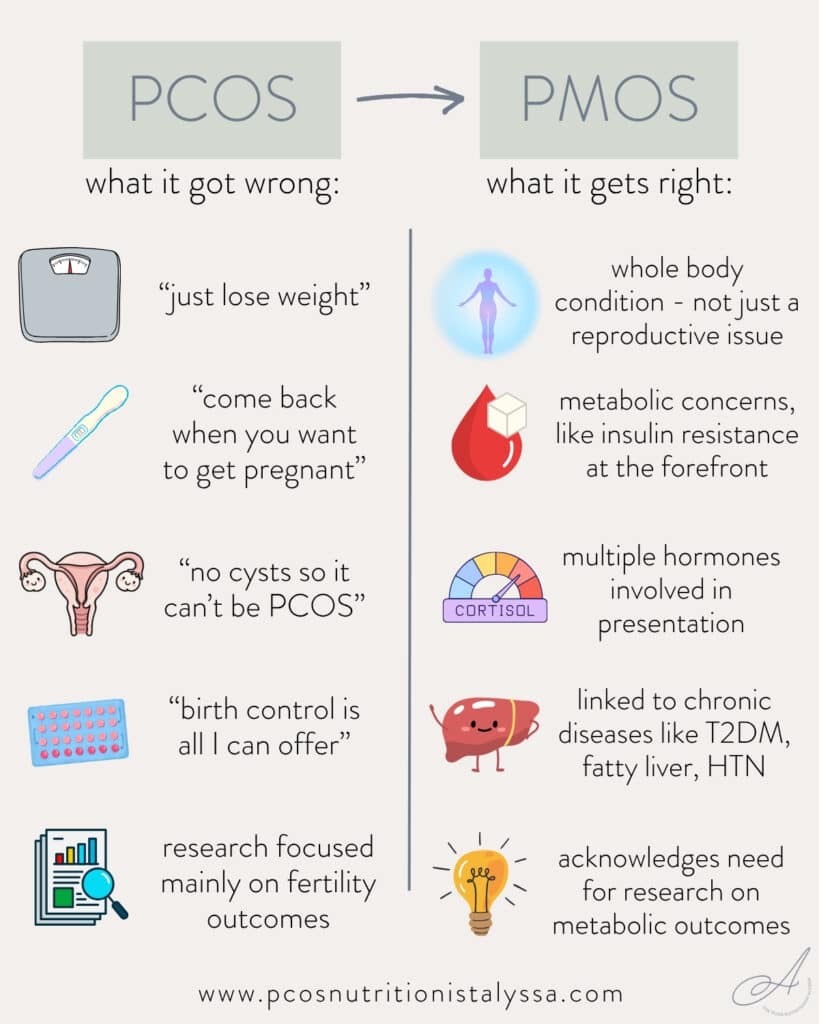
The name implies that this is a condition that’s limited to the ovaries or reproductive system, while ignoring the metabolic complexities that are involved. Many people with PCOS do not have cysts on their ovaries at all, while meeting the other criteria for a PCOS diagnosis.
Because of the old name, there was a lot of misunderstanding around this condition. Diagnosis rates, how the condition was treated, and how much research funding were all affected by the name “polycystic ovary syndrome”.
As a PCOS dietitian, I can tell you that the confusion around the name has come up in my work more times than I can count. Clients who were told their PCOS diagnosis was wrong because their ultrasound “looked normal.” Or those who thought they didn’t need to worry about their heart health or blood sugar because their doctor had only ever framed PCOS as a fertility issue. The name matters…and changing it matters.
What Does PMOS Stand For
Since you’ll be seeing this term a lot going forward, here’s what each piece of the new name actually means:
- Poly: meaning multiple, or more than one.
- Endocrine: relates to hormones and the glands that produce them (think insulin, androgens like testosterone and DHEA, cortisol, thyroid hormones).
- Metabolic: relates to how the body processes energy, including blood sugar regulation, weight, and cardiovascular health.
- Ovarian: relates to the ovaries, acknowledging that ovulatory dysfunction and reproductive health remain defining features of the condition.
- Syndrome: a collection of symptoms that tend to occur together.
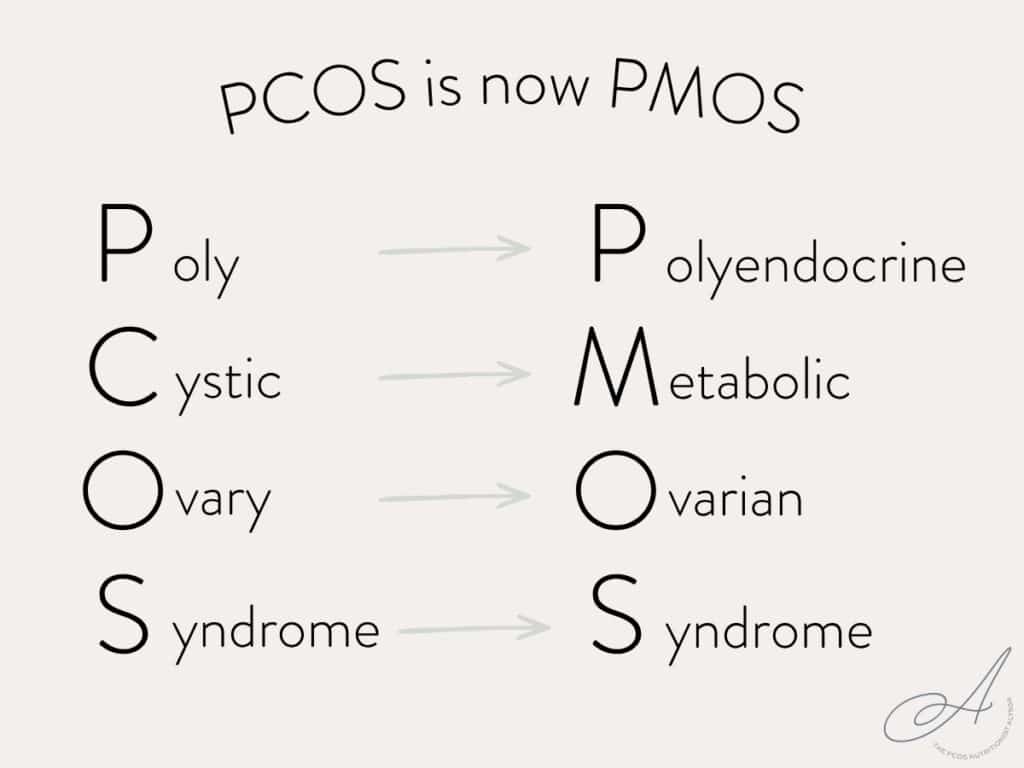
Put it all together and you have a name that says: this is a condition involving multiple interacting hormones, with significant metabolic implications, that can also affect ovarian function. That’s a far more complete and accurate picture than “cysts on the ovaries.”
What the New Name PMOS Gets Right
There’s a lot to appreciate here, and I want to give credit where it’s due.
“Polycystic” was Misleading
Despite the name, many people with PCOS don’t have ovarian cysts at all. Polycystic-appearing ovaries on ultrasound are actually common in people without PCOS, especially in younger women. On the contrary, plenty of people who meet every other diagnostic criteria for PCOS have completely normal-looking ultrasounds. This has led to real diagnostic failures. Dropping “polycystic” from the name is long overdue.
“Polyendocrine” Reflects the Whole-body Reality
PMOS is not just about one hormone or one organ. It involves insulin, androgens like testosterone and DHEA-S, neuroendocrine hormones, and the complex ways they interact with each other. The word “polyendocrine” finally acknowledges that complexity and signals to doctors that this condition requires a whole-body approach, not just a reproductive one.
“Metabolic” Acknowledges Insulin Resistance
This might be the most meaningful addition for the people I work with. Insulin resistance is present in an estimated 80% of people with PCOS. It’s often the driving force behind many of the most frustrating symptoms like stubborn weight gain, irregular cycles, high testosterone levels, energy crashes and fatigue.
Yet for decades, the metabolic dimension of this condition was underemphasized, undertreated, and underfunded. Including “metabolic” in the name is a signal that this piece of the picture deserves serious clinical attention.
Better Research and Funding
Since PCOS was historically categorized as a reproductive or gynecological condition, a significant share of research dollars went toward fertility outcomes, while the cardiovascular, metabolic, and mental health dimensions were neglected. Reclassifying PMOS as a complex multisystem endocrine condition has the potential to attract new funding streams and broaden the scope of research in ways that could genuinely benefit patients.
Concerns About the New PCOS Name
While I do like and appreciate the name change, I do have some concerns about the name.
Transition Time
PCOS has been the name of this condition for over 90 years. Millions of people have been diagnosed and communicate with their doctors using that term. The shift to PMOS is going to take time.
Patients will go to doctors who haven’t heard the new name yet. Insurance coding will lag. Research databases will use both terms simultaneously for years. And someone newly diagnosed who Googles “PCOS symptoms” may not find what they need if the content has already shifted.
Researchers have acknowledged this concern and have published a transition roadmap. However, the reality is that real-world healthcare systems move very slowly so this will not be a quick changeover.
Ovarian Still in Name
One of the goals of the rename was to move away from the perception that this is primarily a reproductive or gynecological condition. Yet the word “ovarian” remains prominently in the name. I understand the reasoning for this is that the ovaries are genuinely affected but it doesn’t fully resolve the issue of PMOS being perceived as “just a period problem” by doctors or patients who don’t look deeper.
A Broken System Prevails
This is probably my biggest concern. The name PCOS has been associated with dismissal, delayed diagnosis, and inadequate treatment for decades. Changing the name doesn’t automatically change the way doctors are trained, the way appointments are conducted, or the way this condition is prioritized in medical education. People with PMOS will likely still be told to “just lose weight.” Metabolic risk factors will still be overlooked and undertreated.
A new name can create an environment for better care but it doesn’t guarantee it. That requires continued advocacy, updated clinical guidelines, and a fundamental shift in how this condition is taught and treated.
What This Means for You
If you currently have a PCOS diagnosis, here’s what you actually need to know:
- Your diagnosis is still valid. Nothing has changed about the diagnostic criteria. You do not need to be re-diagnosed.
- You don’t need to use PMOS right away. For the foreseeable future, most doctors, insurance systems, and online communities are still going to use PCOS. Using PMOS with a provider who hasn’t encountered the term yet may create more confusion than clarity. Know both terms, understand the distinction, and use whichever works best in context.
- Your treatment approach doesn’t change. The nutrition strategies, lifestyle interventions, and supplements that are evidence-based for PCOS remain evidence-based for PMOS. Focusing on blood sugar balance, adequate protein, anti-inflammatory eating, and supporting insulin sensitivity is still the foundation.
- Use it as an opportunity to advocate for yourself. If you’ve ever had your symptoms minimized or been told your condition is only an issue when you want to conceive, this name change gives you language to push back. PMOS is a polyendocrine, metabolic condition and you deserve care that addresses the whole picture.
- Watch for guideline updates. The researchers have committed to updating clinical guidelines, medical education materials, and international disease classification systems as part of the transition roadmap. This process will take a few years though.
The Bottom Line
The renaming of PCOS to PMOS is a meaningful step forward. It’s more scientifically accurate and it validates what so many people have been saying for years. This condition is so much more than cysts on the ovaries, and it deserves to be treated as the complex, multisystem, lifelong condition it truly is.
At the same time, a name change is just a beginning. The real work still lies ahead such as better diagnostic practices, more comprehensive treatment, and increased research funding. The advocacy this community has done for decades is still just as important as it ever was.
Whether you call it PCOS or PMOS, you deserve care that takes all of it seriously: hormones, metabolism, mental health, skin, fertility, and more.
If you’re looking for support navigating this condition with a personalized, evidence-based approach, my team works 1-on-1 with clients through health insurance. Learn more here.
More PCOS/PMOS Posts You’ll Love
2-Minute PCOS Type Quiz: What’s Your Root Cause
15+ Celebrities with PCOS/PMOS