


Have you been seeing Amare Happy Juice all over your social media feed lately? The claims seem almost too good to be true – or is Amare Happy Juice actually worth it?
As a registered dietitian, let me break it down for you. In this blog post, I’m going to discuss what’s in Amare Happy Juice, what the research says about it, and give my unbiased and honest review of this product.

What is Amare Happy Juice?
Amare Happy Juice is a dietary supplement made by the company Amare Global, an international multi-level marketing company (aka MLM company).
Happy Juice is a combination of two different individually packaged powdered drink mixes: MentaBiotics and Amare EDGE+ (we’ll talk more about each of these drink mixes in detail below!). MentaBiotics is available in a raspberry hibiscus flavor or an unflavored option. Amare EDGE+ is available in mango, watermelon, or grape flavors.
The website advises: mix one stick pack of MentaBiotics and one stick pack of Amare EDGE+ with 16-20 oz of water. Adjust water level to suit your taste preference and enjoy!
Alright, so Happy Juice is two different drink mixes that you combine with water, but what does Amare claim that Happy Juice can do for you?
Amare Happy Juice Health Claims
Happy Juice is a combination of two different products: Amare EDGE+ and MentaBiotics. To make it a bit easier to follow, I’m going to break down the health claims of Happy Juice as the combination it’s sold as – and then also the health claims of each product in the Happy Juice combo since they can be purchased individually through the website.
According to the Amare website, Happy Juice:
- Supports mood, motivation, cognitive performance, attention, and memory.
- Provides comprehensive gut nutrition for stress resilience.
- Promotes natural serotonin, dopamine, and GABA production.
- Supports normal cortisol levels and a healthy stress response.
- Optimizes mental flow, productivity, and your capacity to tackle the day.
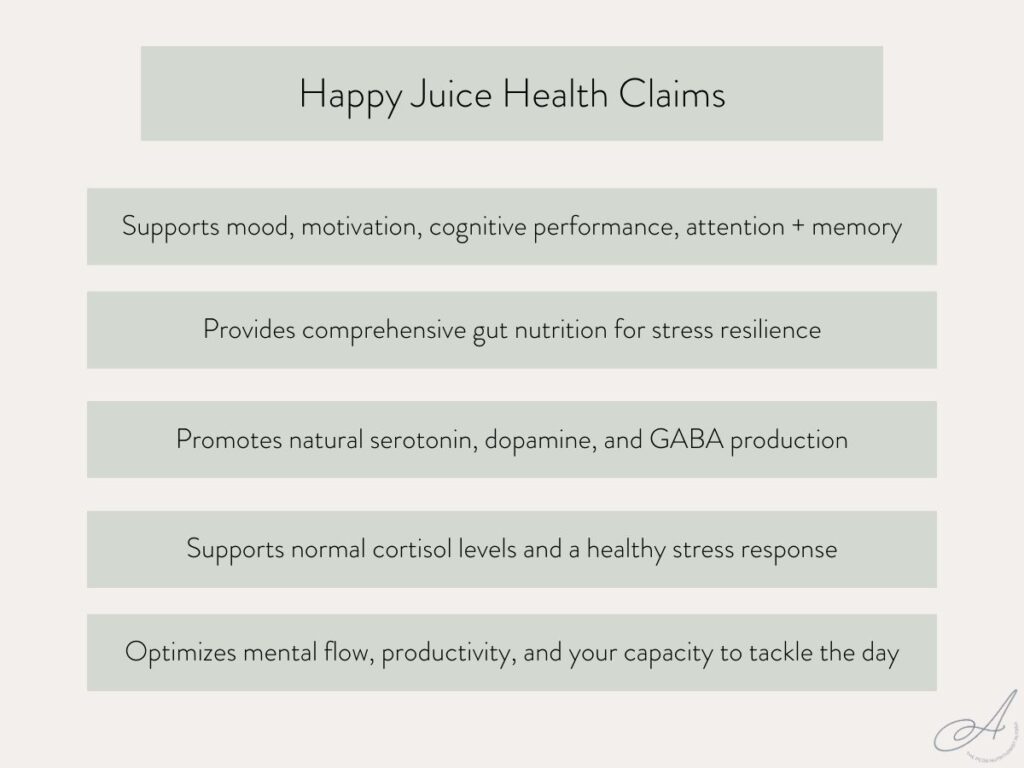
Remember, these health claims above are for the Happy Juice Pack, which is a combination of two different products: Amare EDGE+ and MentaBiotics. Let’s dive into what the Amare website claims each of these products can do individually.
Amare EDGE+ Health Claims
According to the Amare website, Amare EDGE+ a synergistic blend of mango leaf, lychee fruit, and palm fruit, plus lion’s mane for a healthy memory. It also contains citicoline, a precursor to neurotransmitters. Amare EDGE+ optimizes the brain for mental flow, body and mind endurance, healthy memory, and neuron regeneration.
There’s three different flavors available for this supplement: mango, watermelon, and grape. The watermelon and grape flavor contain no caffeine. The mango flavor has green coffee beans (caffeine) added to it to support body and mind energy.
MentaBiotics Health Claims
According to the Amare website, MentaBiotics is advanced gut-brain nutrition formulated to support mental wellness. It’s a combination of probiotics, prebiotics, and phytobiotics.
The website claims that MentaBiotics:
- Supports the body’s natural production of serotonin, dopamine, and GABA.
- Supports feelings of well-being.
- Supports emotional regulation.
- Supports a happy gut.
MentaBiotics claims rely heavily on the gut-brain axis, which is the two-way communication network between your gut and brain. The gut-brain axis links the central nervous system and the enteric nervous system in the digestive tract. This connection can influence overall mood, cognition, digestion, immune system, hormones and overall health. The idea behind these health claims is that if you can support gut health, you can support your mental health, mood, and overall health.
What’s In Amare Happy Juice?
As mentioned previously, Amare Happy Juice Pack is a combination of two Amare products: Amare EDGE+ and MentaBiotics. Let’s break down what’s in each of these products and whether the ingredients can actually substantiate any of the impressive health claims made by Amare.
What’s In Amare EDGE+?
Amare EDGE+ is the newer version of the original Amare Edge. This product is different from the original Amare Edge because it includes nootropics in every flavor option.
Both Amare EDGE+ and MentaBiotics (which we’ll talk about next) contain proprietary blends of ingredients. Think of proprietary blends like a secret recipe. The company will tell you the ingredients that are in the proprietary blend, but not how much of each individual ingredient. This is noteworthy because when it comes to dietary supplements like this, the dose matters.
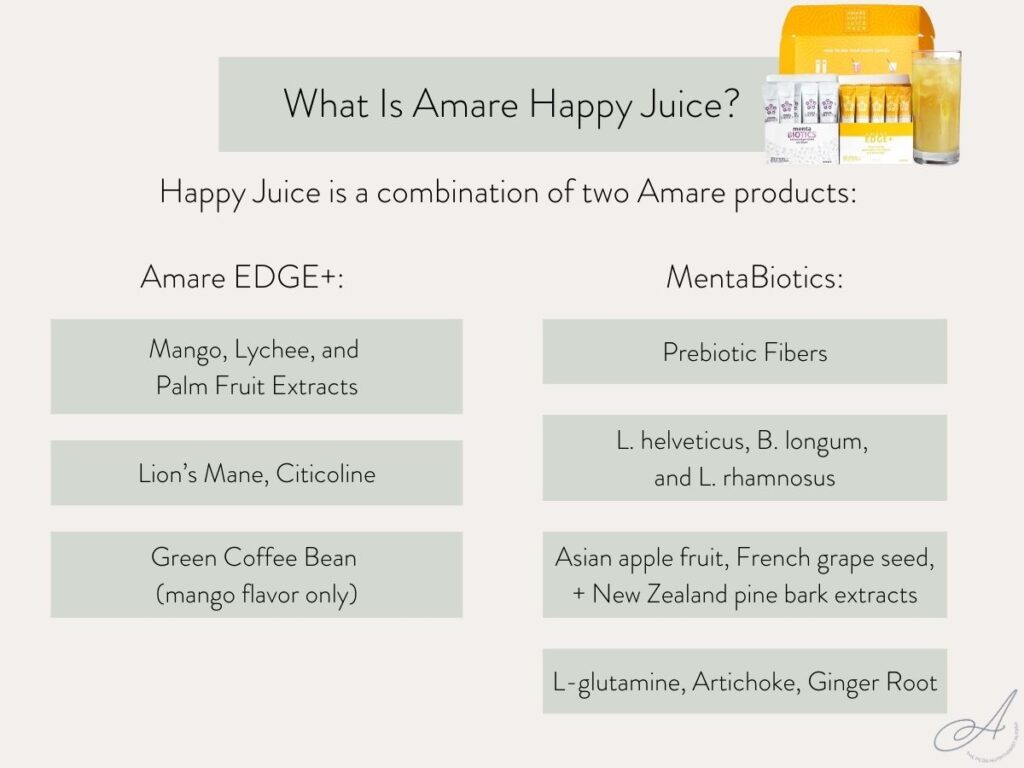
Here’s what’s in all flavors of Amare EDGE+:
- Amare Edge Proprietary Blend: a combination of different fruit extracts such as mango leaf, lychee fruit, and palm fruit.
- Neuron Regeneration Proprietary Blend: this proprietary blend is a combination of the powerful nootropic lion’s mane and citicoline. Citicoline is another natural nootropic. Nootropics are gaining popularity for brain health and their ability to improve mood, short-term memory, and cognitive function in adults (1, 2).
- Other Ingredients: xylitol, natural flavor, citric acid, malic acid, turmeric powder (color), IMO fiber, salt, stevia, safflower oil powder, beet root powder (color).
One flavor option, mango, also has the addition of green coffee beans as a natural caffeine source. The mango flavor provides 100 mg of natural caffeine. The two other flavors, watermelon and grape, do not contain the added caffeine source.
Can Amare EDGE+ Do What It Claims It Does?
Maybe? Probably not though? This all goes back to the proprietary blends honestly. The ingredients in here aren’t bad – they’re actually fine to be honest. Are they enough, though? Probably not.
Let’s start with the first proprietary blend in here. Mango leaf, lychee fruit, and palm fruit are all very nutrient dense options. They’re packed with antioxidants such as polyphenols and flavonoids. We know that these things are great for us. There’s only 200 mg of this proprietary blend and the therapeutic dosage for any of these fruit extracts is either just below or more than this amount. Essentially, you can’t be getting enough of each of these ingredients from this supplement.
The same is true for the second proprietary blend that includes lion’s mane and citicoline too unfortunately. These nootropics show a lot of promise honestly. I recently did a deep dive review of Nütrops Daily Gummies, a functional mushroom and nootropic supplement so I’m well versed on the research behind lion’s mane in particular.
Read my full Nütrops Mushroom Gummies Review here.
The recommended dosage to get the brain-boosting and potential benefits is usually 1000 to 1500 mg of lion’s mane per day. The research for citicoline is also pretty impressive but the therapeutic dose is 250 to 500 mg per day. Based on the fact that the proprietary blend of lion’s mane and citicoline is only 150 mg, there’s no way you’re receiving close to the therapeutic doses for either of these ingredients.
In the mango flavor, you’ll get 100mg of caffeine, which is about the same as a cup of coffee. This will certainly give you an energy boost, which may give you a false sense of productivity or effectiveness, leading you to believe the supplement is working when the energy is primarily coming from the caffeine rather than the other ingredients. If it’s the caffeine you’re after, there’s a lot more affordable ways to get caffeine into your daily routine.
Alright, let’s move onto MentaBiotics.
What’s In MentaBiotics?
MentaBiotics is a proprietary blend of probiotics, prebiotics, and phytobiotics.
Here’s what’s in MentaBiotics:
- MW3 Prebiotic Proprietary Blend: a blend of different prebiotic fibers like iso-malto- and galacto- oligosaccharides, and galactomannan fiber. Prebiotic fibers are a food source for probiotics or the good gut bacteria. This prebiotic blend also contains a patented form of L-theanine. L-theanine is a naturally occurring amino acid known to support the nervous system and promote calmness, sleep, and relaxation.
- MW3 Probiotic Proprietary Blend: this probiotic blend contains 3 billion CFUs (colony forming units). Probiotics are live and active bacteria or microorganisms that support a healthy gut microbiome. The specific strains of probiotics in this blend are 3 types of Lactobacillus and Bifidobacterium species: Lactobacillus helveticus, Bifidobacterium longum, and Lactobacillus rhamnosus.
- Amare GBX+ Proprietary Blend: a combination of phytobiotics, or plant-based compounds that support health. The phytobiotics in this proprietary blend are patented forms of Asian apple fruit extract, French grape seed extract, and New Zealand pine bark extract.
- Digestive Performance Proprietary Blend: a blend of L-glutamine, artichoke leaf extract and ginger root extract. L-glutamine offers gut support by strengthening the intestinal barrier and decreasing intestinal permeability (often erroneously referred to as “leaky gut”).
- Other Ingredients: natural flavors, citric acid, stevia
Can MentaBiotics Do What It Claims It Does?
Maybe? Maybe not? Most of these ingredients do have some pretty cool research to support Amare’s claims. Here’s the catch though: we don’t know how much is in each of the proprietary blends. Is it enough of any ingredient to make a difference in your gut health or mental health? That’s unknown…and it could vary person to person anyways.
The specific strains in this probiotic seem to be intentionally chosen. Specifically, Lactobacillus helveticus R0052 and Bifidobacterium longum R0175 are two probiotic strains that have been researched and found to specifically improve mood and lower anxiety levels (3, 4, 5). That doesn’t mean that other probiotic strains don’t also improve mood and anxiety, because they can.
The reality is that there’s only 3 grams of dietary fiber (and ultimately prebiotic fibers) and 3 billion CFUs in this supplement, which leads me to believe it’s not going to be making any significant improvements in your health if you don’t have other health-promoting habits in place.
For context, most Americans fall short on meeting the recommended guidelines for dietary fiber daily (you’re only going to get prebiotics if you eat fiber!). The USDA’s Dietary Guidelines for Americans recommends that adults eat 14 grams of fiber per 1000 calories of food. That typically equates to a daily fiber goal of 25 grams of fiber per day for women and 38 grams of fiber for men. So 3 grams of fiber from this supplement can help you get to your fiber goal, but it’s essentially a drop in the bucket. You can (and should be) get adequate amounts of fiber from a balanced diet that includes fruits, vegetables, whole grains, legumes, nuts, and seeds.
Grab a high-fiber foods list (and a free PDF download) here.
Additionally, if I’m recommending a probiotic supplement to someone to improve their gut health, I generally look for a higher amount of CFUs per serving (typically 10 billion CFUs or higher to start). Of course, everyone is different so maybe 3 CFUs would be sufficient for some people.
Pros
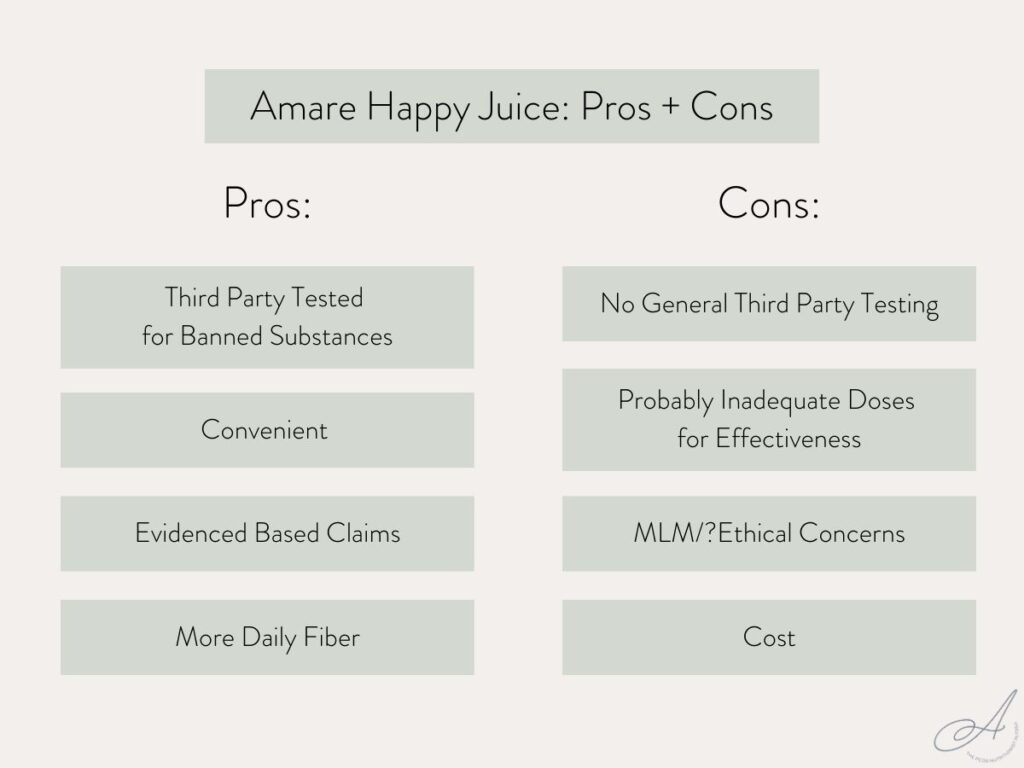
- Convenient. For someone who is looking for a supplement that’s easy to incorporate into their day, these individually packaged supplements make it convenient to take on-the-go or travel with.
- More Fiber. Most Americans fall short on getting adequate fiber into their daily diet. This may offer an easy way to get 3 grams of fiber into your diet. But if you’re only trying to get more fiber, there are more affordable ways to do this.
- Evidence Based. While some supplements make outlandish claims in regards to what their supplements can do, the ingredients in Amare Happy Juice Pack do appear to have clinical studies that back up its’ health claims.
Cons
- No General Third Party Testing. The supplement industry is not regulated in the same way that the food industry is. The Food and Drug Administration (FDA) does not regulate or approve of any dietary supplements, their labeling, or health claims. It’s not uncommon to find supplements on the market that don’t actually have what they’re advertising inside their supplements. Unfortunately, it seems like Amare products are tested in house rather than by an unbiased third party lab such as NSF. They do have the BSBG Drug-Free Certification, however, this seems to just screen for substances that are usually banned in sports. I’ve reached out to the company for clarification and will update this post if I hear back from them.
- Possibly Inadequate Dosages. Given the use of proprietary blends, we have no idea how much of each ingredient is actually in this supplement. For example, we know that many of the ingredients in this supplement can help with various symptoms, but are these ingredients included in amounts that can actually make a difference? That remains unknown.
- Multi-Level Marketing. Amare Global is a direct-sales company that uses multi-level marketing to promote their products. This may not be a con for you, however, it’s something to be aware of in case supporting MLM companies doesn’t align with your values.
- Potential Digestive Upset. Increasing your dietary fiber and probiotic intake may lead to digestive discomfort or upset for some people. These potential side effects are usually short-term but may persist for some individuals.
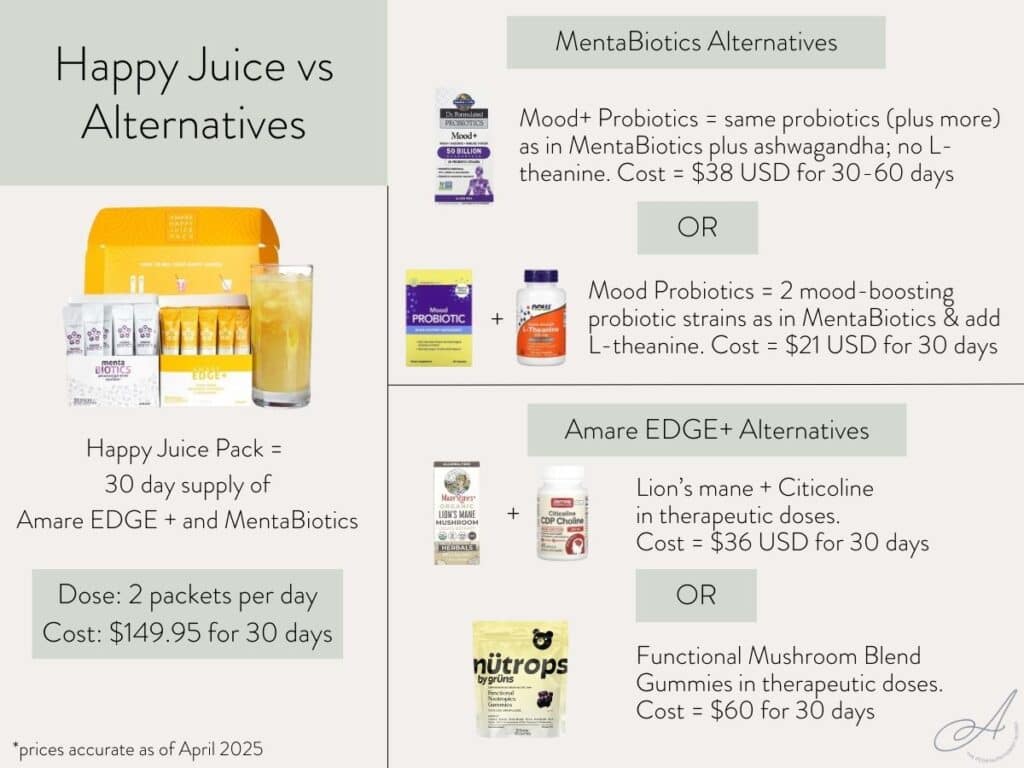
- Cost. This is absolutely the biggest con in my opinion. A 30-day supply of Amare’s Happy Juice Pack will cost you $149.95 USD if you opt into their “subscribe and save” option. If you choose to not subscribe, it will cost you $166.95 USD for the 30 day supply. Finding lower cost alternatives is remarkably easy and I’ll highlight some options below.
My Honest Amare Happy Juice Review: Is It Worth It?
Maybe? Maybe not? Unfortunately, I don’t have a straight answer for you. The answer is ultimately going to depend on you and your unique needs.
Happy Juice Packs are mainly formulated with proprietary blends. Proprietary blends don’t disclose the exact amount of each ingredient, which makes it impossible to know if you’re getting an effective dose. Just because an ingredient is included doesn’t mean there’s enough of it to actually work. It’s like adding a pinch of coffee grounds to a giant pot of water—you won’t get a strong cup of coffee, just flavored water. The right dose is what makes the difference between something being effective or just a marketing gimmick.
That said, the risk of harm from trying something like Happy Juice is minimal for most healthy adults. I’m not one to tell you where to spend your money, I just want to ensure you can make an informed decision. If the convenience factor of something like Amare Happy Juice Packs align with what you want to spend your money on, then go for it. You may see a positive effect on your mental well-being and gut health as a result.
If you’re looking for an alternative to the cost of this product, let me outline some thoughts.
Amare Happy Juice Pack Alternatives
There isn’t necessarily a singular product that I know of that is a direct substitute for Amare Happy Juice. If you’re looking for similar ingredients though at a fraction of the cost, you could consider one of the products listed below.
MentaBiotics Alternatives:
- Mood+ Probiotic: This probiotic option contains all 3 of the same probiotics that are available in MentaBiotics. It doesn’t contain L-theanine like MentaBiotics, which is a calming compound. Instead, it contains ashwagandha, which is a powerful adaptogen that can help your body respond more efficiently to stress. This probiotic contains 50 billion CFU in 2 capsules – you could even take just one capsule to get ~25 billion CFU, and you’re still getting significantly more probiotics than MentaBiotics.
- Mood Probiotic: This probiotic contains a mixture of the Lactobacillus helveticus + Bifidobacterium longum combo, which has been researched for its ability to improve mood and lower anxiety. If you decided to go with this probiotic option and wanted to add the additional benefits of L-theanine, which is found in MentaBiotics, you could consider 100 or 200 mg of L-theanine supplementation.
- Prebiotics: Maybe this is the dietitian in me, but I just cannot get behind paying money for a prebiotic supplement when you can (and should be) easily getting these from a healthy diet. For context, ½ cup of oats will give you 4 grams of dietary fiber with 2-3 grams of that being prebiotic fiber – about the same amount of prebiotic fiber in MentaBiotics. Read more about fiber here.
- Digestive support: the digestive performance proprietary blend in MentaBiotics is not anywhere close to a therapeutic dose so I personally wouldn’t even bother trying to replace it.
Amare EDGE+ Alternatives:
I don’t find the Amare EDGE+ supplement to be worth it at all. It can offer you some great antioxidants, but then again, so can fruits, vegetables, whole grains and other health-promoting foods.
If you’re interested in the potential benefits of nootropics, exploring those types of supplements in more therapeutic doses may be worthwhile. Here’s a couple of options to consider:
Of course, the cons of purchasing these types of supplement alternatives is that you’d need to sacrifice the convenience of a powder for capsules (or gummies in some cases). That may be a worthwhile tradeoff for someone who wants to get the benefits of certain ingredients without the Amare price tag.
If you’re considering trying any dietary supplement, it’s extremely important to speak with your medical doctor or healthcare provider before starting anything new. People view supplements as benign because they’re often considered natural. However, there can be side effects or medication interactions. Your healthcare provider can advise you if they’re a safe option for you given any personal health conditions you may have.
The Bottom Line: Amare Happy Juice Review
Happy Juice is a dietary supplement made by the company Amare Global, which is a direct sales MLM company. It’s a combination of two Amare products: Amare EDGE+ and MentaBiotics. Each product is a powder that’s packaged in a single-serve, convenient packet. Happy Juice contains a mixture of prebiotic fibers, probiotics, phytobiotics and various plant compounds.
Research does support that the ingredients found within Happy Juice can help with mood, mental clarity, cognitive function, your body’s stress response, anxiety levels, and gut health. Unfortunately, Happy Juice is a combination of different proprietary blends. So we don’t know if there’s enough of any certain ingredients to actually be an effective dose.
In my opinion, this product is overpriced for what it is. If you feel your health could benefit from the ingredients in this product, you could find them for a much lower price tag from other brands (see the above section for some recommendations). It just would not be as conveniently packaged.
Other Dietary Supplement Reviews
A Dietitian’s Review of Unicity Balance
ARMRA Colostrum: Is It Worth It?
An Honest Review of True Sea Moss
Happy Mammoth Hormone Harmony Review
A Dietitian’s Review: Mixhers Hertime + Metabolic Balance
Disclaimer: this is for informational purposes only. It does not substitute for or replace professional medical advice. Always consult with your healthcare provider prior to starting any new supplements.

8 Responses
Yes. I have a friend who’s persistent on the Happy Juice but I’m not going to pay that plus I think it’s a scam.She said oh it will help your anxiety and my gut issues. I don’t eat well because I have no one to help me to plan on what I really need to eat. Since I had my gallbladder removed it’s been difficult to find the rite diet.and I’ve loss to much weight which I didn’t need to. And recommendations?
Hi Julie, thanks for your comment! I’d highly recommend seeking out a local registered dietitian if you’re able to. Most health insurance plans will cover a certain number of sessions per year at minimal/no cost to you. They’d be a great resource to be able to give you more personalized recommendations that will work for you!
This was very helpful. I’m trying to follow and pay attention to more dieticians and nutritionists on social media platforms than influencers. Abbey Sharpe is a fave of mine bc she tells it like it is, and I think you do too. Thank you for being transparent and giving us the facts.
I’m glad this was helpful for you, Jess! I love Abbey Sharpe too – she always has lots of great info!
I currently am using Happy Juice and so far, my digestion and bowel movements have been better. My sleep quality has improved. I no longer have to take Zoloft, and I am able to get through my boring desk job without being fidgety or distracted. I am going to tell people about it and let them try it for themselves. As you stated it will do differently for each individual based on their needs. It is not more expensive per day than Starbucks coffee or an energy drink. The only complaint I have so far is it does taste like a vitamin and that’s hard to drink for me personally. I have found that less water works best for me. Did you just try it for taste, or did you do a full cycle?
I’ve been drinking Happy Juice for a few weeks and I think it may be making me dizzy. Is there anything in it that you think could cause dizziness?
Everyone reacts differently so it could very well be causing dizziness – there are a lot of ingredients in here that have the potential to cause dizziness in some people.
Thank you for this helpful and insightful review. I was about to order Amare and just had a weird feeling about it and found this review. I ordered the Nutrops instead.