With more people searching for answers to manage their PCOS symptoms, there’s a growing interest in natural remedies like essential oils for PCOS in recent years. These powerful plant extracts are said to help in managing symptoms such as hormonal imbalances, stress, and inflammation.
If you’re wondering about essential oils for PCOS, you’re not alone in your curiosity. As a registered dietitian who specializes in PCOS, I get asked about natural remedies like this all the time.
In this post, we’ll explore which essential oils are actually worthwhile for PCOS, which symptoms they may alleviate, and how to incorporate them into your wellness routine to help you find relief and balance. Plus, I’ll give you a few oil blend recipes!!
This post may contain affiliate links for your convenience. This means that if you click on a link and make a purchase, I may receive a small commission at no additional cost to you.
What Are Essential Oils?
Essential oils are concentrated plant extracts. They’re made by steaming or pressing parts of a plant, like flowers, leaves, bark, or fruit, to capture the compounds that create fragrance. The process can take several pounds of a plant to produce a single bottle of essential oil.
Essential oils can be used in aromatherapy and are often either inhaled or topically applied to the skin. Occasionally, essential oils may be ingested, however, you should never take essential oils by mouth unless instructed by a trained and qualified specialist.
Do Essential Oils Help PCOS?
Polycystic ovarian syndrome (aka PCOS) affects a lot of women…approximately 1 in 10 women of reproductive age to be more precise. Common symptoms of PCOS include irregular periods, infertility, weight gain, mood swings, fatigue, hair loss, hirsutism (aka unwanted hair growth), acne, anxiety and depression.
While the exact cause of PCOS isn’t known yet, this condition seems to be rooted in hormonal imbalances. PCOS has been linked with insulin resistance, chronic inflammation, and high androgen levels (aka male hormones like high testosterone levels). As a result, women with PCOS are at higher risk for other medical conditions such as type 2 diabetes and cardiovascular disease.
The use of essential oils is touted as more of a holistic approach for many health problems, including for symptoms of PCOS. While there isn’t a ton of research that has been done on those with PCOS specifically, there are some oils that may alleviate or improve specific symptoms of PCOS.
In the following sections, I’m going to outline some of the best essential oils for PCOS and a variety of ways to use them. It’s important to note though that while essential oils can complement other treatment approaches, they should not replace medical advice or prescribed treatments for PCOS. Always consult with your healthcare provider before starting any new therapy.

Ok, let’s dive into what the best essential oils for PCOS are and what the research actually says.
The Best Essential Oils for PCOS
As I mentioned before, there hasn’t been a ton of research done on essential oils for PCOS specifically. So what we often need to do in these situations is to take the research that we do have and consider if it can be applied to specific concerns, or symptoms, of PCOS.
Here are some of the best essential oils that you should consider for your PCOS symptoms.
Clary Sage Essential Oil
Clary sage essential oil is frequently mentioned as one of the best essential oils for PCOS…and for good reason! This essential oil holds many potential benefits that PCOS-ers can benefit from.
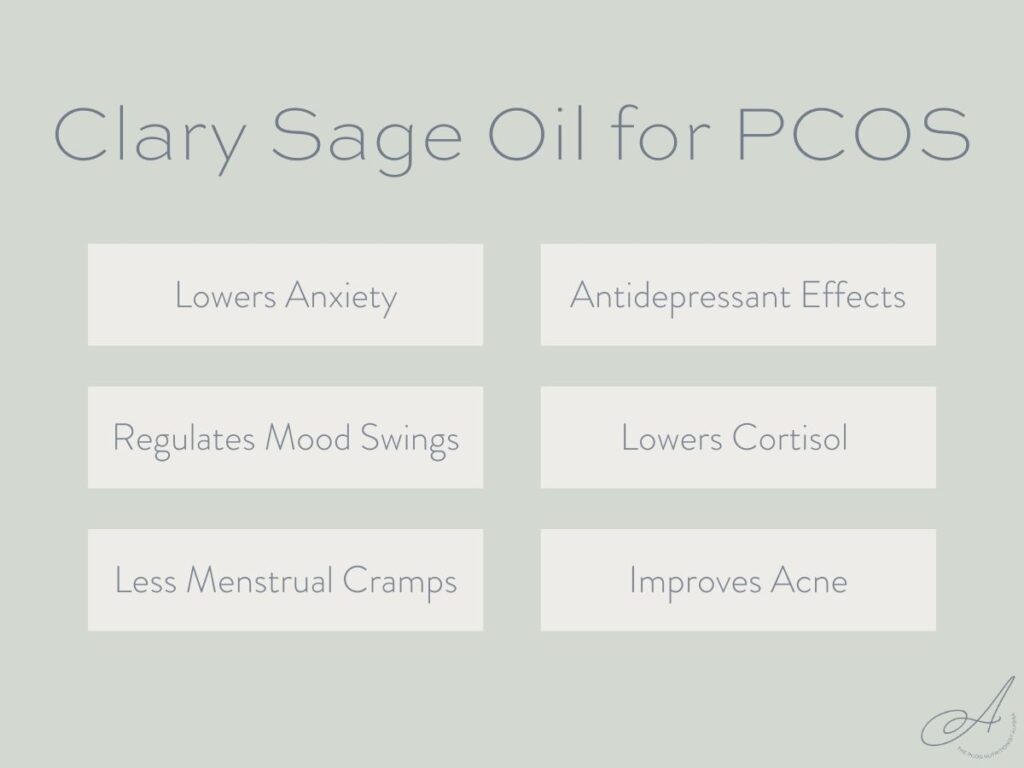
One study found that inhalation of clary sage oil has antidepressant effects and can significantly lower cortisol levels. Clary sage oil is also known for its anti-anxiety properties. It’s helpful for regulating mood swings and menstrual cramps for those with premenstrual syndrome (aka PMS) (1).
These are all particularly interesting since women with PCOS tend to have higher cortisol levels and higher rates of anxiety and depression than women without PCOS.
Clary sage oil also contains antioxidants and exhibits anti-inflammatory properties. Since PCOS is known to be an inflammatory condition, this is great news.
Because of its anti-inflammatory and antimicrobial properties, clary sage oil has been used more recently to manage certain skin conditions such as acne. For treating skin conditions, it can be mixed with a carrier oil and applied topically or it can be mixed into a moisturizer or facial wash.
PCOS symptoms that clary sage oil may address: high cortisol levels, depression, anxiety, inflammation, menstrual cramps, mood swings, acne.
Geranium Essential Oil
This essential oil has anti-inflammatory, antimicrobial, and antibacterial properties. It is particularly beneficial for use on oily or acne prone skin. Additionally, it has been shown to be helpful for managing eczema. It can be diluted in a carrier oil, face wash, or moisturizer and applied topically to get these skin benefits.
Geranium essential oil may also be helpful in promoting healthy hair growth, which is something that some women with PCOS struggle with (2). To promote hair growth, this essential oil can be mixed with a carrier oil and applied to your scalp, or a few drops can be added to your shampoo.
Geranium essential oil can also be beneficial for reducing stress and anxiety. It can be diffused or inhaled to promote these benefits.
PCOS symptoms that geranium essential oil may address: acne, oily skin, eczema, hair loss, weak hair, stress, anxiety.
Ylang Ylang Essential Oil
This essential oil has a strong fragrance, but is known for its calming effects and anti-anxiety properties. Some preliminary research also suggests that it may be helpful for lowering blood pressure, which is pretty cool!
Ylang ylang essential oil also has anti-inflammatory and antimicrobial properties, which are beneficial for skin and hair. Many people also use ylang ylang to increase libido and sexual desire…something that can be affected in those with PCOS.
Ylang ylang can be diffused in a diffuser or applied topically after diluting with a carrier oil like jojoba oil or coconut oil.
PCOS symptoms that ylang ylang essential oil may address: anxiety, high blood pressure, inflammation, libido, hair loss, acne.
Cinnamon Essential Oil
The benefits of cinnamon are well documented in both the general population and the PCOS population. Cinnamon can help to significantly improve glucose levels and insulin resistance.
In fact, a small study of 15 women with PCOS found that cinnamon extract significantly improved insulin sensitivity. These results were consistent with previous animal studies too.
Cinnamon oil is also helpful for reducing cholesterol levels, oxidative stress, and inflammation, which are commonly elevated in PCOS. Additionally, cinnamon oil may help to improve menstrual cycle regularity, which can help to improve fertility as well.

Cinnamon also smells delicious, like the perfect fall day. The smell of it can easily be enjoyed by diffusing cinnamon oil in a diffuser. Additionally, it can also be diluted with a carrier oil and applied topically.
Some people enjoy mixing a small amount, such as one drop, of cinnamon oil into food or drink, such as a smoothie or your morning coffee to obtain these benefits. Always speak with your healthcare provider regarding the safety of ingesting essential oils.
PCOS symptoms that cinnamon oil may address: insulin resistance, high glucose levels, high cholesterol levels, inflammation, oxidative stress, irregular menstrual cycles
Lavender Essential Oil
Even if you’re not an essential oils expert, you’ve probably heard of lavender essential oil. This popular scent is known for its stress relief and calming effects. It can also promote more restful sleep, something that often seems elusive when you have PCOS (3).
A few drops of lavender essential oil into your diffuser or even right onto your pillow at night can promote relaxation and more restful sleep. It can also be mixed with a carrier oil and applied topically to obtain these benefits too.
PCOS symptoms that lavender essential oil may address: anxiety, stress, poor sleep, fatigue.
Sandalwood Essential Oil
Known for its woodsy and sweet smell, sandalwood essential oil has more benefits than just a nice scent. Sandalwood essential oil has anti-inflammatory properties, which may be helpful to lower inflammation that’s commonly seen with PCOS.
When applied topically, it can help to relieve anxiety (4). Since anxiety affects up to half of those with PCOS, sandalwood essential oil may be a useful piece of your PCOS management toolbox.
Additionally, sandalwood oil may help to promote healthy skin. It has anti-aging properties and can act as a natural astringent. This can make it effective for treating skin problems like acne or dark spots, which are common PCOS symptoms. Sandalwood oil can be mixed into skincare products, such as face wash.
PCOS symptoms that sandalwood essential oil may address: anxiety, inflammation, acne, dark spots, or oily skin.
White Cedar Leaf Oil
Thuja occidentalis essential oil, or commonly known as white cedar or cedar leaf oil, may be a helpful treatment option for those with irregular cycles. One animal study found that Thuja occidentalis essential oil significantly increased estrogen and progesterone levels. It also significantly lowered luteinizing hormone (LH), testosterone levels, LDL cholesterol, blood sugar levels, and leptin levels (5).
White cedar oil can be used in a diffuser or applied topically with a carrier oil. It can be toxic in large doses so it’s important to exercise caution with white cedar oil.
PCOS symptoms that white cedar leaf essential oil may address: irregular periods, high cholesterol, high blood glucose levels, leptin resistance and food cravings, high testosterone levels, high LH levels, estrogen and progesterone imbalances
Spearmint Oil
Have you heard that spearmint tea is great for PCOS? It’s true that this herbal tea can decrease high testosterone levels and hirsutism (aka that excess hair growth). Spearmint oil may hold some of the same benefits as well. A recent study found that carvone, the main volatile constituent in spearmint oil and peppermint oil, has beneficial effects on PCOS (6).
Animal studies have found beneficial effects of spearmint oil for PCOS. One study found that spearmint oil orally reduced body weight, testosterone level, ovarian cysts and restored follicular development in ovarian tissue (7).
Spearmint oil is known to have anti-androgenic properties…aka it can lower androgen levels, such as testosterone levels. This minty oil also has anti-inflammatory and antibacterial properties.

Because of these properties, spearmint oil can be particularly beneficial in fighting acne, oily skin, hirsutism, dandruff, or dry scalp…all of which are more common in PCOS because of high androgen levels. To help reduce these symptoms with spearmint oil, simply add a few drops of it to your shampoo bottle, facial wash, or moisturizer.
Aside from applying spearmint oil topically, benefits of spearmint oil can be enjoyed by diffusing this oil also.
PCOS symptoms that spearmint essential oil may address: weight gain, high testosterone levels, hirsutism, acne, oily skin, dandruff, dry scalp, ovarian cysts, follicle maturation and improved ovulation.
Fennel Essential Oil
This essential oil has a warm and earthy scent that’s similar to licorice, while also providing some impressive potential benefits for PCOS.
Fennel essential oil may be beneficial for those who struggle with high DHEA-S levels, which may erroneously be referred to as adrenal PCOS. One study found that a combination of fennel essential oil and black cumin essential oil significantly decreases LH levels and DHEA-S levels. Additionally, this combination decreased the amount of ovarian follicles seen on ultrasound.
Another PCOS animal study found that fennel oil improved body weight & BMI, serum glucose, insulin levels, progesterone, and HOMA-IR (aka a calculation used to determine the severity of insulin resistance).
Fennel oil also has antimicrobial and anti-inflammatory properties, which are helpful for those struggling with oily skin and acne. It can be mixed with a carrier oil or into your face wash or moisturizer and applied topically. Fennel oil can also be used in a diffuser.
PCOS symptoms that fennel essential oil may address: weight gain, insulin resistance, high glucose levels, low progesterone levels, ovarian follicles, LH levels, DHEA-S levels, acne, oily skin.
Thyme Essential Oil
You’ve probably heard of the spice thyme, but it can also be an essential oil too. Thyme essential oil can be beneficial for PCOS since it has the ability to reduce anxiety, something that we’re at a higher risk for.
This oil also has anti-inflammatory and antioxidant properties that can help lower inflammation…and in turn, potentially decrease androgen levels too in PCOS.
In addition to its anti-inflammatory properties, thyme oil is also an antimicrobial and antifungal agent. It can be a helpful addition to any skincare regimen to help combat acne.
PCOS symptoms that fennel essential oil may address: inflammation, anxiety, acne, oily skin.
How To Use Essential Oils For PCOS
As I mentioned throughout the sections above, there are different ways to use essential oils for PCOS symptom management. The best approach will likely depend upon what you prefer and which symptoms you’re trying to manage. For example, if you’re primarily trying to heal your acne, you may want to consider topical application to get the maximum benefit.
Let’s talk about a few ways you can use essential oils for PCOS.

Diffuse
This is one of the most popular ways to use essential oils. There’s different options here, such as a reed diffuser or an ultrasonic diffuser. I prefer the latter, which requires you to add some water and a few drops of essential oils into your diffuser. The diffuser will then dispense a mist into the air so you can inhale, or breathe in, the essential oils.
I love this beautiful and affordable diffuser. Put it in a high traffic area of your home, such as your home office or your bedroom.
Topically
Topical application is another great option for many people. It’s especially helpful for targeting specific PCOS symptoms like hirsutism, acne, or hair loss.
Remember though, essential oils are potent. There are very few oils that are safe to apply directly to your skin. Instead, you’ll want to add your essential oils to a carrier oil, such as coconut oil or jojoba oil, to dilute the essential oils. Then you can apply it topically to your skin.
Some people find that they enjoy using certain oils often, so they may prepare it in advance and put the essential oil and carrier oil mixture into roller bottles like these. You can then apply the roller bottle whenever you feel the need to. Some common areas to apply would be the wrists, neck and shoulders, or lower abdomen and back.
Some essential oils can also be mixed into your shampoo, face wash or facial moisturizer too, depending on which symptom you’re targeting.
Pre-Made Products
If you’re not interested in being your own essential oils barista, that’s ok too! You can still usually find some products that utilize essential oils in them. This is one example of a lotion that incorporates lavender and chamomile essential oils to promote calm and relaxation. This is another company that offers personal care products with their essential oils inside already.
Favorite PCOS Blends
If you’re interested in creating your own PCOS essential oil blends, I’ve got you covered! All you’ll need to have are:
- Essential oils of your choosing (I prefer this brand and this brand for essential oils because they’re high quality while also being affordable)
- Carrier oil of choice (usually almond oil, jojoba oil, castor oil, or fractionated coconut oil)
- Roller bottles
Once you have your supplies, you can get blending!
To make the blends below, just combine all ingredients into a roller bottle. Gently turn the roller bottle upside down and back to mix the ingredients.
Note: if you’re using 10ml roller bottles, you will not be able to fit a full tablespoon of oil in – just fill the roller bottle with jojoba oil until it’s full.

Anti-Hirsutism Blend
This one is best for fighting unwanted hair growth like those pesky chin whiskers!
Here’s what you’ll mix up:
- 4 drops spearmint essential oil
- 3 drops lavender essential oil
- 3 drops tea tree essential oil
- 1 tablespoon jojoba oil (or another non-comedogenic carrier oil)
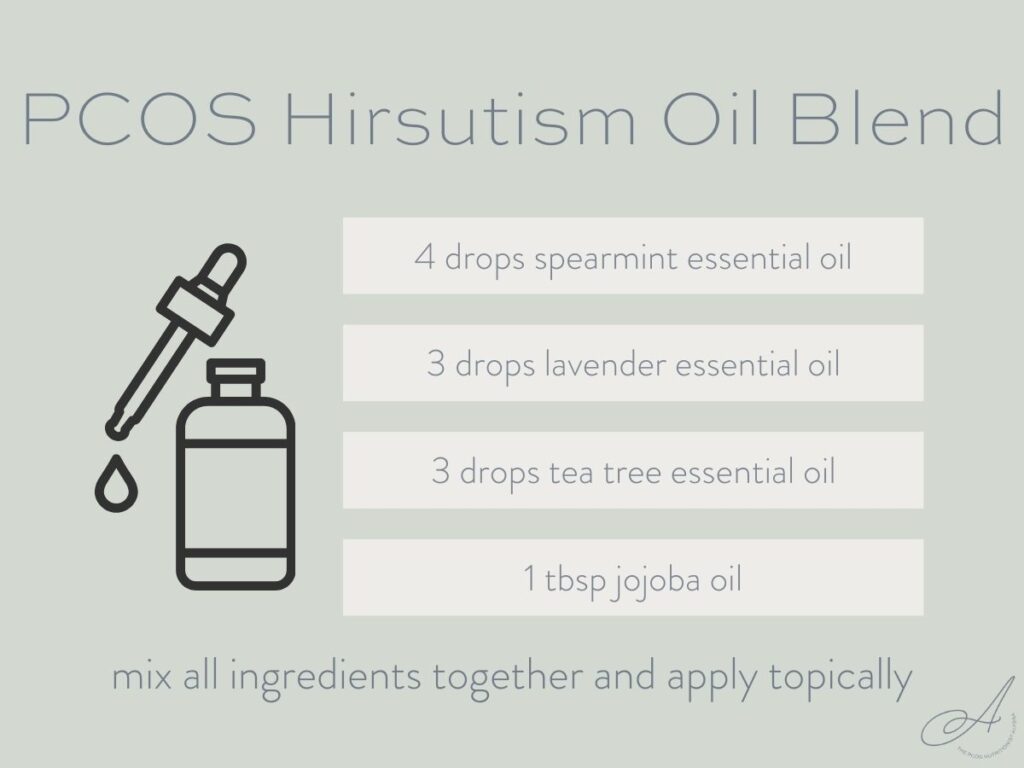
It’s best advised to apply this oil blend topically to wherever you’re experiencing hirsutism, or unwanted hair growth. Always do a patch test first.
Acne Fighter Blend
This blend is a great addition if you’re trying to combat acne and reduce scarring.
Here’s the ingredients:
- 3 drops tea tree essential oil
- 3 drops lavender essential oil
- 2 drops frankincense essential oil
- 2 drops geranium essential oil
- 1 tablespoon jojoba oil (or another non-comedogenic carrier oil)
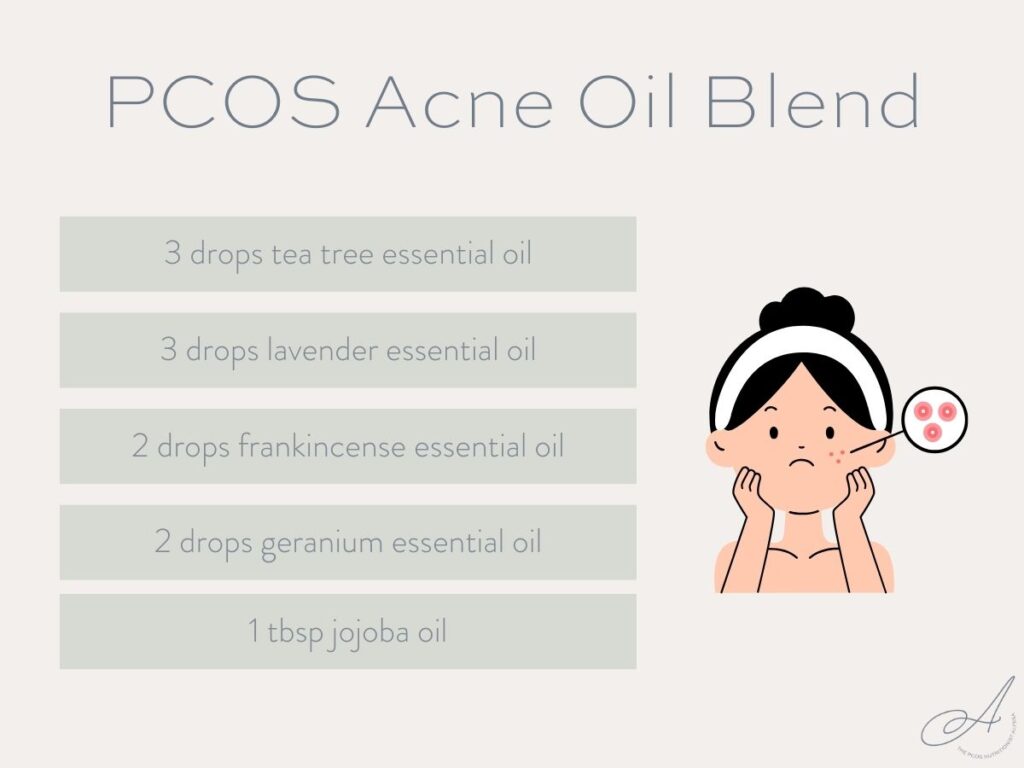
It’s best to apply this blend topically to wherever you experience acne. Always do a patch test first before using.
Stress Relief Blend
To lower anxiety, keep this blend on hand for stress reduction!
You’ll need these ingredients to make it:
- 4 drops lavender essential oil
- 4 drops bergamot essential oil
- 3 drops frankincense essential oil
- 3 drops ylang ylang essential oil
- 1 tablespoon jojoba oil (or another non-comedogenic carrier oil)
This is a great one to travel with for whenever you need a little stress support! Roll onto wrists, neck, shoulders, or behind your ears.
Boost Your Fertility Blend
This essential oil blend may help to improve ovulation and boost your fertility.
Here’s the ingredients:
- 3 drops clary sage essential oil
- 3 drops geranium essential oil
- 3 drops lavender essential oil
- 2 drops frankincense essential oil
- 1 tablespoon jojoba oil (or another non-comedogenic carrier oil)
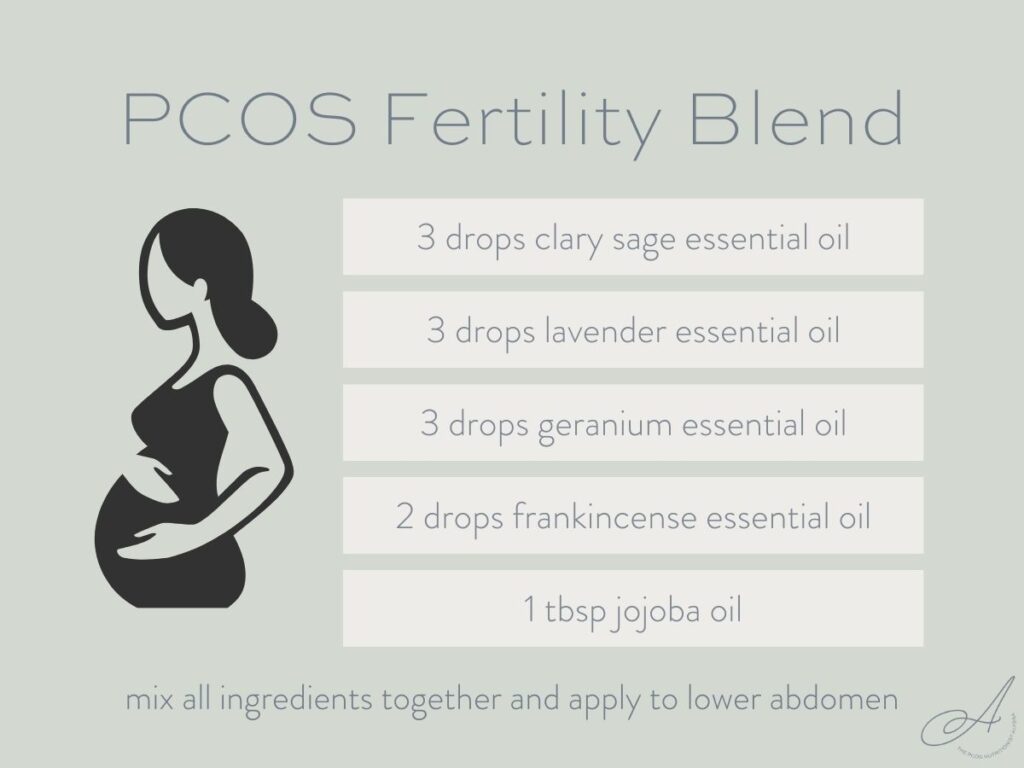
Apply it to the lower abdomen. It can be particularly helpful when applied topically during the two weeks leading up to ovulation.
PCOS Sleep Blend
Need some more sleep? This oil blend can be a nice addition to your bedtime routine.
Here’s what you’ll need:
- 4 drops mandarin essential oil
- 4 drops lavender essential oil
- 3 drops roman chamomile essential oil
- 2 drops frankincense essential oil
- 1 tablespoon jojoba oil (or another non-comedogenic carrier oil)
You can roll this blend onto your wrists, neck, ears, or even your pillow before bedtime.
The Bottom Line
Essential oils can be a complementary approach to managing PCOS symptoms, in addition to a healthy diet and lifestyle changes.
Clary sage, geranium, ylang ylang, cinnamon, lavender, sandwood, white cedar leaf, spearmint, fennel, and thyme essential oils may hold benefits for those with PCOS.
Essential oils can often be used in a diffuser or applied topically once mixed with a carrier oil.
Always consult with your healthcare provider before starting or stopping any new treatment options.
Other Posts You’ll Love
PCOS Self-Care: 10 Natural Ways to Manage Your Health
A Dietitian’s 7 Day PCOS Diet Plan PDF
Disclaimer: this is for informational purposes only. It is not intended to substitute for or replace professional medical advice. It is not intended to diagnose, treat, or cure any symptoms of polycystic ovary syndrome (PCOS) or any other medical conditions. Always consult with your healthcare provider for personalized medical and treatment recommendations.