Is Tempdrop a worthwhile investment? I’ve tried Tempdrop so I’m going to give you my full Tempdrop review including the pros and cons, how it works, and who could benefit from using a Tempdrop sensor.
If you’re new here, hi! I’m Alyssa, a registered dietitian who specializes in women’s health, specifically PCOS. So I’m no stranger to helping women regulate and properly track their cycles and ovulation.
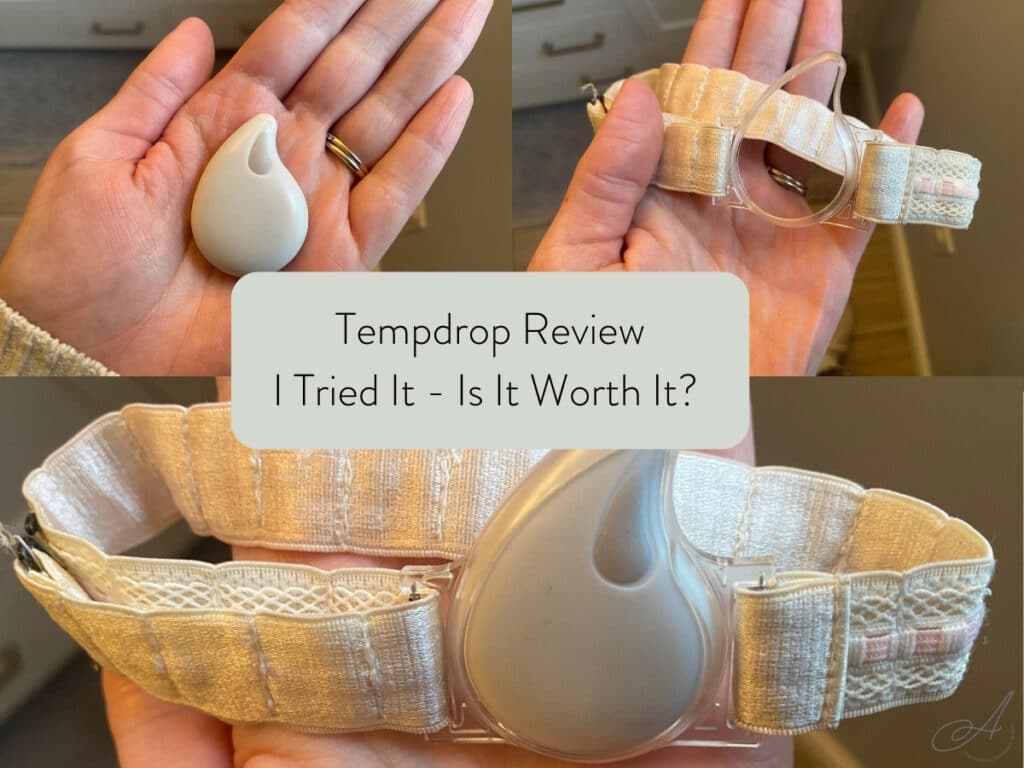
What is the Tempdrop Fertility Tracker?
Tempdrop is a smart, wearable thermometer that helps you better track and understand your menstrual cycles. Essentially, this device can tell you when your body has ovulated.
The Tempdrop sensor is worn on your upper arm overnight while you sleep. It records your basal body temperature (BBT) for ovulation tracking purposes and syncs your daily temperature reading to the Tempdrop app. Within the Tempdrop app, it plots your daily temperature readings in an easy-to-read chart.

How Does Tempdrop Work?
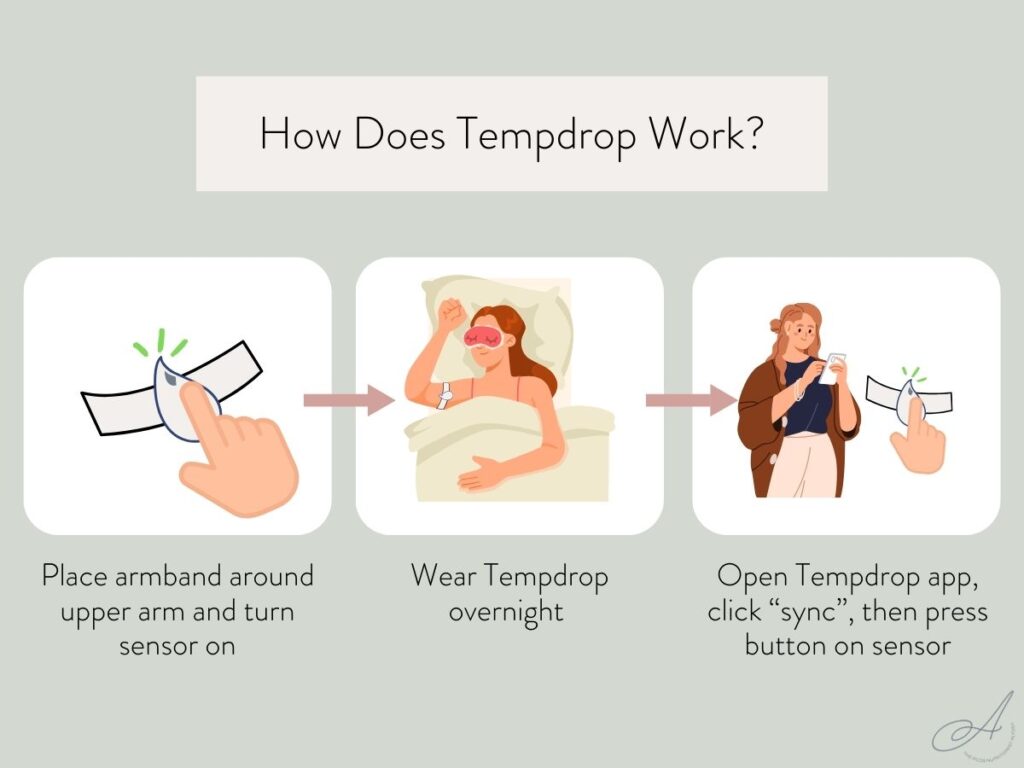
Tempdrop is a small sensor that’s shaped like a teardrop. You place the sensor inside an armband that comes with your Tempdrop purchase. At night, you place the armband around your upper arm, turn the sensor on, and go to sleep.
While you’re sleeping, the Tempdrop sensor is continuously monitoring your core temperature (aka your basal body temperature). Tempdrop’s smart technology uses a patented algorithm to also learn your body’s unique nightly and monthly temperature patterns. This helps to filter out disturbances for the most accurate results.
Upon waking up in the morning, you’ll open up the Tempdrop app on your phone, click “sync Tempdrop” and then push the small button on your Tempdrop sensor until the light flashes quickly. The app then uploads your overnight basal body temperature (BBT) and plots it in an easy-to-read chart.
Within the Tempdrop app, you can also track other fertility signs and symptoms that may help with cycle tracking, such as:
- Menstruation
- Cervical mucus
- Cervix position
- Intercourse timing
- Ovulation test results
- Physical symptoms such as headaches, tender breasts, cramps, bloating, energy levels, sex drive, or PMS symptoms
- Whether you may be sick or had an alcoholic beverage, which may skew BBT results
Let’s quickly touch on how Tempdrop differs from traditional BBT tracking before moving on.
Tempdrop vs Traditional BBT Tracking
Tempdrop offers a smarter alternative to traditional BBT tracking. With traditional BBT tracking, you would need to be incredibly diligent in tracking your oral temperatures using a digital BBT thermometer each morning.
Traditional BBT tracking requires at least 3 hours of consecutive sleep to get an accurate reading. This oral temperature reading must be taken first thing in the morning, at the same time everyday, and while you’re laying down in bed before even sitting up. You then need to manually record the temperature and monitor for slight temperature changes to identify ovulation.
Since traditional BBT tracking requires at least 3 hours of consecutive sleep to get an accurate reading, it can be really difficult for some people. If you have irregular sleep patterns, are a shift worker, or are just woken up at different times in the middle of the night (such as those with small children), traditional BBT tracking may not give you accurate information.

With a wearable device like Tempdrop, your body is continuously measuring your temperature while you’re asleep and learns your typical patterns to give you more accurate results. Tempdrop also relies on a smart algorithm so the rules are less rigid. The only requirement is that two hours of sleep must be detected to get an accurate BBT reading, although the sleep does not have to be consecutive.
You also don’t have to worry about tracking everything manually either – the only thing you have to remember to do is wear the armband at night then sync it the following day.
Let’s discuss how to wear the Tempdrop sensor and then we’ll dive into how to read the charts and what the Tempdrop app offers.
To try Tempdrop, use this link or enter code AFALYSSA at checkout for a discount.
How To Wear Tempdrop
To wear the Tempdrop sensor, you simply slip the armband (with sensor inserted) onto your upper arm. The narrow part of the teardrop shape should point towards your elbow.
The sensor should lay flat against your arm firmly. It shouldn’t be too tight that it’s uncomfortable, but it does need to maintain contact with your skin throughout the night.

If you’re a restless sleeper, fear not. As long as your Tempdrop armband is not too loose against your skin, you’ll be able to accurately use this!
I tend to toss and turn some nights, but my Tempdrop has never had an issue with that.
The Tempdrop App
Once you purchase a Tempdrop device, you have ongoing use of the free Tempdrop app which is available for iOS and Android.
The free app gives you the ability to:
- Sync and view your daily BBT readings in the app’s chart
- Log additional symptoms that may be helpful for cycle tracking such as menstruation, cervical mucus, ovulation predictor kit test results, cramping, breast tenderness, etc.
With the free version, you have to self-interpret your results by looking at your chart. If you do have regular ovulation, this is fairly simple to do. This is the way I personally utilize the Tempdrop device!
There’s also a premium version of the Tempdrop app that costs $6 USD per month or $48 per year. The premium version gives you more options and automatically will “read” your charts for you and give you fertility insights. The app will clearly tell you when it anticipates ovulation will occur, your fertile window, and then when you’ve actually ovulated.
With the premium version, you’re also able to track sleep habits and there’s an educational course called “Tempdrop Academy”. This is a mini course that teaches fertility awareness and all things cycle tracking.
How To Read Your Tempdrop Chart
Below are some screenshots of my own Tempdrop charts. I use the free version of the Tempdrop app. I’ve been tracking my cycle for years so I know that my cycles are usually 28 to 30 days in length…and that I typically ovulate between cycle days 15 to 18, most often though on cycle day 16 or 17.

The app keeps track of the actual date and your cycle day. It then automatically plots your BBT reading onto the chart and connects each days’ readings with a solid black line. If you accidentally skip a night wearing your Tempdrop device, your chart will connect your next BBT reading with a lighter dotted line on the graph. As you can see, I’m good for skipping a few days each cycle – but it still shows you really valuable data!
Ovulation is the key event that Tempdrop can confirm. This is when your body releases an egg, and it normally happens about 10 to 16 days prior to the start of your menstrual cycle.
Your body’s core temperature experiences different changes in temperature depending on your hormone levels. These temperature fluctuations are very slight and not something that we outwardly feel.
In the 1 to 2 days leading up to ovulation, your body’s core temperature will decrease slightly. Then, in the 1 to 2 days after ovulation, your body’s temperature (aka BBT) will rise ever so slightly…usually just by 0.5 to 1 degree Fahrenheit.
Once your period shows up though, your BBT will plummet back down to baseline.
Can I use Tempdrop if I have PCOS?
Yes, you can use Tempdrop if you have PCOS or irregular cycles. People with PCOS often have irregular periods because of delayed ovulation or anovulation. This means that their body doesn’t ovulate regularly, which causes irregular periods. For example, someone with PCOS may ovulate on day 18 one month, then not ovulate until day 45 during their next cycle.
Even with irregular periods and PCOS, when your body does actually ovulate, your BBT will still rise. This will trigger the temperature increase seen on the Tempdrop charts. So if your goal is to confirm when your body has ovulated (which can allow you to anticipate when your period will arrive), Tempdrop is a game changer and great option!
If you have PCOS and want to try Tempdrop, use this link or enter the code AFALYSSA at checkout for a discount.
Does Tempdrop Predict Ovulation?
Yes and no. If you opt to pay for the premium version of the Tempdrop app, your app will start to predict your fertile window based on your past ovulation and cycles. If you use the free version, you do not gain access to this clear-cut ovulation prediction.
If you have regular cycles and know which day you typically ovulate, you can generally predict when you’re in your fertile window.
However, if you have irregular cycles and delayed ovulation, you may ovulate on day 16 one month then day 42 the following month. While the Tempdrop device will successfully be able to identify when you’ve actually ovulated in this situation, it likely won’t be able to accurately tell you when you’re in your fertile window (even with the paid premium version).
If you’re trying to conceive, knowing when you’re about to ovulate is valuable information to know since you’ll want to appropriately time intercourse prior to ovulation.
Since Tempdrop works by measuring your BBT, your temperature will slightly decrease 1-2 days before ovulating. Looking at your BBT readings and Tempdrop charts, it’s not always super obvious that your temperature decreased pre-ovulation until after you actually ovulated. You’re also fertile for up to 6 days prior to ovulation, so you could be missing out on key fertile days by relying only on BBT readings.
If you need to accurately predict ovulation before it happens, I’d recommend pairing Tempdrop with another tool, such as ovulation predictor kits or the Inito or Mira fertility monitors. These types of options use your urine to measure various hormone levels that increase as ovulation approaches, which can give you a clearer picture of your fertile window.
You can read my full comparison of the Mira vs Inito fertility monitors here.
Pros of Tempdrop
- Confirms Ovulation. Since Tempdrop measures your BBT, it’s a reliable tool to confirm whether or not your body has ovulated.
- Irregular Cycles or PCOS. Even if your cycles are irregular, you can still use Tempdrop since it relies on your internal BBT to tell you when your body has ovulated.
- Shift Workers or Irregular Sleeping Patterns. If you have irregular sleep schedules because you’re a shift worker (or you just like to sleep in on the weekends), this is a great option. Tempdrop offers a reliable and smarter alternative to traditional BBT tracking.
- Free App. While there is a premium paid version in the app that can make reading your charts even more straightforward, it’s absolutely not necessary to upgrade. The free version in the Tempdrop app can provide you with the information you need. So for most people, the Tempdrop sensor can be a one and done purchase without an ongoing subscription.
- HSA/FSA Eligibility. Many HSA or FSA plans will cover basal body thermometers, including Tempdrop.
- Customer Service. All of my experiences with the customer support team have been helpful. Shipping is available to the US, EU, UK, and several other countries. There’s also a 30 day satisfaction guarantee included with your purchase. You can also choose to purchase the optional 12-month satisfaction guarantee for some extra protection at checkout.

Cons of Tempdrop
- Not The Best Ovulation Predictor. Using Tempdrop by itself isn’t necessarily the best option if you need to predict ovulation in my opinion. For example, if you’re trying to conceive, being able to accurately predict ovulation before it happens is really important. If you fall into this category, I’d recommend pairing Tempdrop with another option, such as ovulation predictor kits or the Inito or Mira fertility monitors.
- Consistency. In order to truly get valuable information from Tempdrop, consistent use is key. You can typically skip a night here or there without issue, but you can’t wear it occasionally and then expect it to tell you if you ovulated.
- Battery Maintenance. The Tempdrop sensor contains a coin cell battery (CR2032) that must be replaced periodically. In my experience, the battery does tend to last for several months, however, it is an annoying task to get the tiny Tempdrop sensor open to change it (this applies to the original Tempdrop sensor). Thankfully, I’ve only had to do it a handful of times over the past several years.
- Cost. Purchasing the Tempdrop sensor is a lot of money. Without any discount codes or promos, the cost is $189 USD for the Tempdrop 2.0. If you opt for the free app though, this is a one time cost.

The Bottom Line
Tempdrop is a wearable thermometer that tracks your overnight basal body temperature (BBT). It then syncs your daily BBT reading to your phone and plots your readings on a chart. The BBT readings and chart are designed to help you confirm ovulation and track your cycles more in depth.
The Tempdrop sensor does come with an expensive upfront cost. Once you have the device though, you don’t necessarily need to regularly pay for anything else. You can use the free app that allows you to track your Tempdrop readings, menstrual cycles, and other physical symptoms. There’s also a premium monthly subscription option that gives you access to more features, although, I don’t think this is necessary to benefit from the Tempdrop device.
If you’re looking for a smart, wearable device that takes the guesswork out of manually recording your basal body temperature, I think Tempdrop is a great option. It’s a useful tool to ongoingly confirm ovulation. I don’t believe it’s the best way to predict ovulation, especially if you have irregular periods. If you want to also accurately predict ovulation, I’d look into using another tool, such as ovulation predictor kits or the Inito or Mira fertility monitors, alongside your Tempdrop.
To try Tempdrop, use this link or enter coupon code AFALYSSA at checkout for a discount.
Other Posts You’ll Love
Inito vs Mira: I’ve Tried Both Monitors – Which Is Better?
Diet Plan To Get Pregnant (Free PDF & Recipes)
Best Prenatal Vitamins for PCOS